

Table of Contents
- Why People Are Switching From Petroleum Jelly
- Petroleum Jelly vs Natural Balms: How They Actually Compare
- Benefits of Grass-Fed Tallow for Skin
- Key Ingredients in Nontoxic Alternatives to Petroleum Jelly
- Cost-Per-Ounce: Natural Balms vs Petroleum Jelly
- How to Choose a Clean Moisturizer for Your Skin Type
- Conclusion
- Frequently Asked Questions
Last Updated: September 11, 2026
Why People Are Switching From Petroleum Jelly
Petroleum jelly has been a drugstore staple for generations, but a growing number of skincare buyers are actively searching for nontoxic alternatives to petroleum jelly. The reason is simple: petroleum jelly is a petrochemical by-product, and many people now want plant-based or animal-based occlusives they can trace back to a farm rather than a refinery.
This guide breaks down what actually works as a replacement, how these options compare on cost and performance, and how to pick one for your skin type.
A common mistake is assuming every "natural" balm behaves like petroleum jelly. It doesn't. Petroleum jelly is almost purely occlusive, meaning it sits on top of your skin and blocks water from escaping. Natural balms can be occlusive, emollient, or humectant depending on what's in them, and that difference changes how your skin responds.
Petroleum Jelly vs Natural Balms: How They Actually Compare
Petroleum jelly and natural balms both slow water loss from your skin, but they do it through different mechanisms and with different ingredient profiles. Petroleum jelly forms a near-total seal. Natural balms made from beeswax, shea butter, or tallow form a breathable protective barrier while also delivering fatty acids and vitamins your skin can use.
That distinction matters for anyone dealing with a compromised skin barrier. A barrier that's stripped from over-cleansing or harsh actives needs more than a seal. It needs lipids it can actually absorb.
Occlusive vs Humectant: What Your Skin Barrier Needs
An occlusive is an ingredient that forms a film on your skin to prevent transepidermal water loss. A humectant is an ingredient that pulls water into the upper layers of your skin. Most healthy skin routines need both, plus emollients that soften and smooth the surface.
| Property | What It Does | Examples |
|---|---|---|
| Occlusive | Blocks water loss, seals the barrier | Petroleum jelly, beeswax, tallow |
| Humectant | Draws water into skin | Glycerin, honey, aloe |
| Emollient | Softens and smooths | Shea butter, jojoba oil, castor oil |
The common advice to "just use Vaseline on everything" ignores this. If your skin is dry and dehydrated, an occlusive alone traps a barrier over skin that's already low on water. Pairing a humectant with a natural occlusive covers both problems.
Benefits of Grass-Fed Tallow for Skin
Grass-fed tallow is one of the closest natural matches to the lipids your skin already produces. Its fatty acid profile is bio-identical to human sebum, which is why it absorbs rather than sitting on the surface like a heavy ointment.
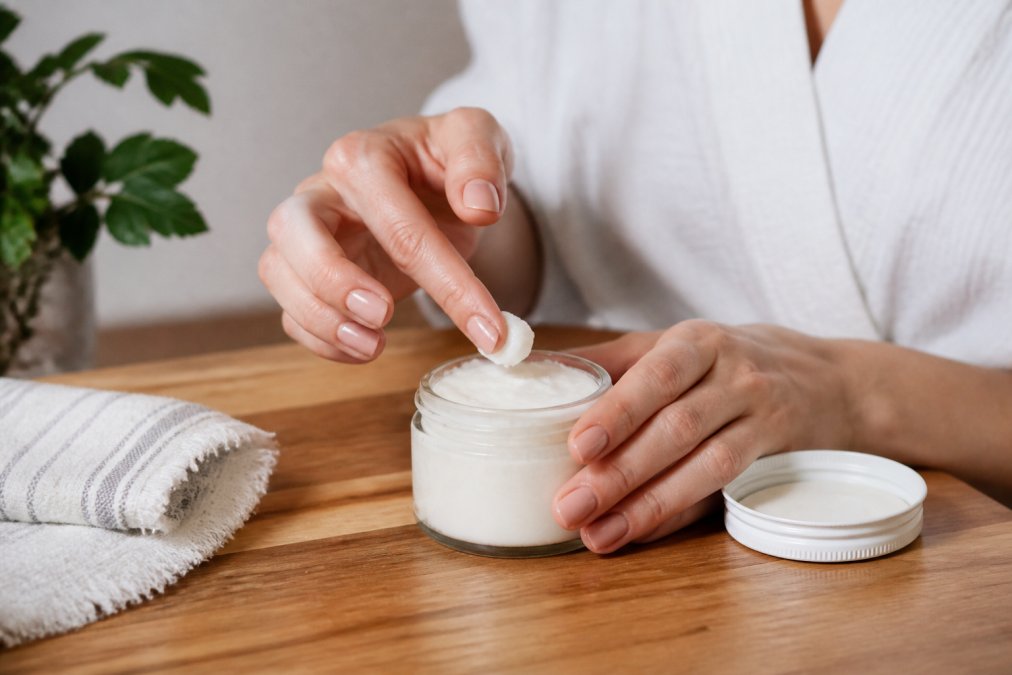
Tallow is naturally rich in vitamins A, D, E, and K, all of which support skin repair and moisture retention. It's also non-comedogenic for most people, meaning it's unlikely to clog pores the way heavier synthetic occlusives can.
What most guides miss is that sourcing changes everything. Tallow from grass-fed, pasture-raised animals has a different nutrient density than tallow from grain-fed feedlot animals.
Key Ingredients in Nontoxic Alternatives to Petroleum Jelly
The best nontoxic alternatives to petroleum jelly combine one occlusive, one emollient, and one or two skin-supporting actives. Reading an ingredient list with that framework makes it much easier to spot a genuinely clean formula versus one with a natural-sounding label.

Ingredients worth looking for:
- Beeswax and shea butter for a protective barrier
- Castor oil and jojoba oil for emollient softening
- Vitamin E as an antioxidant that also extends shelf life
- Grass-fed tallow for a bio-identical lipid base
- Cold-pressed plant oils, which retain more nutrients than heat-processed versions
Ingredients to avoid if you're moving away from petrochemicals: mineral oil, parabens, synthetic fragrance, and anything labeled "natural fragrance," which is a catch-all term with no regulatory definition in US cosmetics labeling.
Look for hypoallergenic, fragrance-free, and dermatologist-tested claims on the label, and check whether the product is non-comedogenic if you're acne-prone.
How the Ingredients Actually Work Together
A balm is not a random blend. It's a ratio. The occlusive-to-emollient ratio determines whether the finished product feels like a stiff salve, a soft butter, or a pourable oil.
Here's how the main categories behave:
| Ingredient | Primary Role | Melting Point Range | Notes |
|---|---|---|---|
| Beeswax | Occlusive / structure | 144-147°F | Firm, matte finish; can feel tacky at high ratios |
| Shea butter | Emollient / occlusive | 89-104°F | Rich, absorbs slowly; unrefined retains more nutrients |
| Cocoa butter | Occlusive / structure | 93-101°F | Hard at room temp; adds chocolate scent unless deodorized |
| Tallow | Emollient / occlusive | 95-113°F | Closest lipid match to human sebum |
| Jojoba oil | Emollient | Liquid at room temp | Actually a liquid wax ester, not a true oil |
| Castor oil | Emollient / humectant-adjacent | Liquid at room temp | Thick, draws moisture; can be sticky |
| Vitamin E (tocopherol) | Antioxidant | Liquid at room temp | Slows rancidity in plant oils |
Shelf Life and Rancidity
Plant oils oxidize. That's the trade-off you accept when you move away from a petrochemical that never goes bad. Cold-pressed oils with high polyunsaturated fat content, like flaxseed or hemp, go rancid in a matter of months. Oils high in monounsaturated fat, like olive and avocado, last longer. Jojoba is technically a wax ester and is one of the most stable options available.
Vitamin E is the standard antioxidant used to slow this process, typically at 0.5 to 1 percent of total formula weight (PubMed). It won't stop rancidity, but it delays it. A well-made tallow or beeswax balm stored away from direct sunlight and heat typically holds for 12 to 18 months (peer-reviewed research). If a balm smells like crayons or old nuts, it has turned, throw it out.
Cost-Per-Ounce: Natural Balms vs Petroleum Jelly
Natural balms cost more per ounce than petroleum jelly. That's the honest answer, and pretending otherwise doesn't help anyone. But "more per ounce" is not the same as "more per use," and most articles never do the math that separates the two.
Petroleum jelly is cheap because it's a refined by-product of petroleum processing. A standard 13-ounce jar of petroleum jelly typically retails between $4 and $7, which works out to roughly $0.30 to $0.55 per ounce (the FDA). Natural balms use raw materials that cost more to source, and small-batch producers don't have the volume to drive unit costs down the way large manufacturers do.
Here's the normalization most guides skip. A typical natural tallow or beeswax balm runs between $2.50 and $5.00 per ounce at retail. That's roughly five to ten times the per-ounce cost of petroleum jelly. On paper, petroleum jelly wins by a wide margin.
Where the Gap Narrows
The per-ounce number assumes you use the same amount of each product. You don't. A whipped tallow balm has a lower density than a solid petroleum jelly, and it spreads further per fingertip.
The other factor is routine consolidation. Petroleum jelly is typically one layer in a multi-step routine: cleanser, serum, moisturizer, then occlusive. A well-formulated tallow balm is often used as the moisturizer and the occlusive in one step. If a $14.99 4-ounce balm replaces a multi-product routine, the total routine spend can drop even though the balm's per-ounce cost is higher.
A Simple Way to Compare
Ignore the sticker price. Calculate cost per month of actual use:
- Estimate how many days the container will last at your usage rate.
- Divide the total price by that number of days.
- Multiply by 30 for a monthly figure.
A $14.99 balm that lasts 90 days costs about $5.00 per month. A $6 tub of petroleum jelly that lasts 120 days costs about $1.50 per month. The gap is real, but it's often less significant than the per-ounce figure suggests.
A 4-ounce Unscented Tallow Balm from Obsessedwithtallow is $14.99, and the smaller scented and unscented jars start at $9.95. Compared to a multi-product routine of serum, moisturizer, and occlusive, that's often a lower total spend.

How to Choose a Clean Moisturizer for Your Skin Type
Choosing a clean moisturizer comes down to three questions: what your skin needs (occlusive, humectant, or both), what your skin reacts to, and how much texture you'll actually tolerate.
For sensitive or reactive skin, start with the shortest ingredient list you can find. Fewer ingredients means fewer chances of a reaction. A single-ingredient tallow balm is often the safest starting point.

For dry or cracked skin, you want a heavier occlusive paired with an emollient. Shea butter and tallow together work well here, especially on heels, elbows, and hands.
For acne-prone or imbalanced skin, avoid heavy plant butters that can feel suffocating. Tallow's bio-identical structure is generally better tolerated than synthetic occlusives, but patch test first.
For babies and children, fragrance-free formulas are the safer default. The Unscented Tallow Balm is designed for exactly this use case, with no essential oils or added fragrance.
Patch Testing Protocol for Sensitive Skin
Patch testing is the single most skipped step in skincare, and it's the one that prevents the worst reactions. Here's a protocol that takes five days:
- Day 1: Apply a small amount to the inner forearm. Leave for 24 hours.
- Day 2: Check for redness, itching, or bumps. If clear, apply again to the same spot.
- Day 3: Apply to the jawline or behind the ear, a more reactive area.
- Day 4: Check again. If still clear, apply to a small patch of face.
- Day 5: If no reaction, begin normal use.
If you react at any stage, stop and wait for the skin to settle before trying a different formula.
Conclusion
The shift away from petroleum jelly isn't about chasing trends. It's about wanting skincare you can trace, understand, and trust on reactive skin. That usually means paying slightly more per ounce for ingredients that do more than seal.
At Obsessedwithtallow, our whipped tallow moisturizers are built on exactly that idea: simple, real ingredients, bio-identical to your skin's natural oils, and rich in vitamins A, D, E, and K. No synthetic fillers, no petroleum by-products, and no fragrance unless you want it.
Get started with Obsessedwithtallow and give your skin a moisturizer it can actually recognize.
Frequently Asked Questions
What can I use instead of petroleum jelly?
Several nontoxic alternatives to petroleum jelly work well as occlusives. Grass-fed tallow balm is rich in vitamins A, D, E, and K and closely mimics your skin's natural oils. Beeswax, shea butter, and jojoba oil are also effective plant-based options. Each provides a protective barrier that reduces transepidermal water loss without relying on petrochemicals, making them suitable for dry, cracked, or sensitive skin.
Is tallow a better moisturizer than petroleum jelly?
Petroleum jelly is a pure occlusive: it seals in moisture but adds no nutrients. Grass-fed tallow contains bio-identical fatty acids plus fat-soluble vitamins that support the skin barrier while providing emollient and occlusive benefits. Tallow also absorbs more readily than petroleum jelly, so it feels less greasy throughout the day. Tallow offers both protection and nourishment.
How do I choose a clean moisturizer that won't clog my pores?
Look for non-comedogenic ingredients like tallow, jojoba oil, or shea butter. Avoid synthetic fillers, parabens, and heavy mineral oil if you are acne-prone. Check labels for fragrance-free or hypoallergenic claims if your skin is reactive. A short ingredient list is usually a good sign. Patch test any new product on your inner forearm for 24 to 48 hours before applying it to your face.
What ingredients should I avoid in conventional occlusive balms?
Common ingredients to avoid include petrolatum (petroleum jelly), mineral oil, parabens, synthetic fragrances, and artificial preservatives. These can irritate sensitive skin or contribute to clogged pores. Instead, look for cold-pressed plant oils, beeswax, shea butter, and grass-fed tallow. Certified organic and fragrance-free options reduce the risk of reactions, especially for eczema-prone or reactive skin types.