

Table of Contents
- Why Is My Tallow Balm Greasy? The Science Behind the Texture
- How to Apply Whipped Tallow for a Non-Greasy Finish
- Tallow Moisturizer for Oily Skin: Does It Clog Pores?
- Grass-Fed Sourcing and the Purification Process
- Ingredient Pairings to Reduce Greasiness
- Common Mistakes When Applying Whipped Tallow
- Conclusion
- Frequently Asked Questions
Last Updated: September 10, 2026
Why Is My Tallow Balm Greasy? The Science Behind the Texture
If you've scooped a balm from a jar, rubbed it in, and watched your face shine like a buttered skillet, you already know the question: does whipped tallow leave skin greasy? The short answer: tallow can feel greasy when too much sits on the surface faster than it can absorb. That's a texture and application problem, not a verdict on the ingredient.
This guide breaks down why the greasy feeling happens, how to apply whipped tallow so it sinks in, and which skin types benefit most.
Tallow is rendered beef fat, traditionally from the suet around the kidneys, slowly melted and purified (PubMed). Its fatty acid profile closely mirrors the lipids your skin already produces, which is why so many people find it compatible. The greasy feeling usually comes down to quantity, timing, and how the balm was made.
How Sebum Compatibility and Fatty Acids Affect Absorption
Your skin produces sebum, a mix of oils that keeps the surface flexible and limits water loss. Tallow's lipid profile includes stearic, palmitic, and oleic acid, similar building blocks to your own sebum (peer-reviewed research). Skin tends to tolerate and absorb fats it recognizes.
But "similar" doesn't mean "instant." Absorption depends on how much you apply, whether your skin is damp, and room temperature. A thick layer of any occlusive balm can only absorb so fast; the remainder sits on top, reflecting light. That's the shine people mistake for a bad product.
The Chemistry of Whipping: How Air Changes the Feel
Whipping is not just for looks. When tallow is whipped, air gets folded into the fat, changing its density and how it spreads. Think of cold butter versus whipped butter: the whipped version melts into toast faster because there's less solid mass per scoop. Whipped tallow behaves the same way on skin, a lighter texture means less product per finger swipe and more even breakdown across your face. That single change solves most of the greasy complaints people have.
How to Apply Whipped Tallow for a Non-Greasy Finish
The most common mistake is treating tallow like a lotion. It isn't. You need far less, applied to damp skin, in a thin layer. But the right surface condition and amount change with your skin type. Here is the routine, then the skin-type adjustments most guides skip.
- Wash your face and leave it slightly damp. Don't towel dry completely.
- Scoop a pea-sized amount with a clean fingertip or spatula.
- Warm it between your fingertips for a few seconds until it turns translucent.
- Press and pat it into your skin, working from the center of your face outward.
- Wait two to three minutes before applying anything else or touching your face.
Damp Skin vs. Dry Skin: A Skin-Type Application Guide
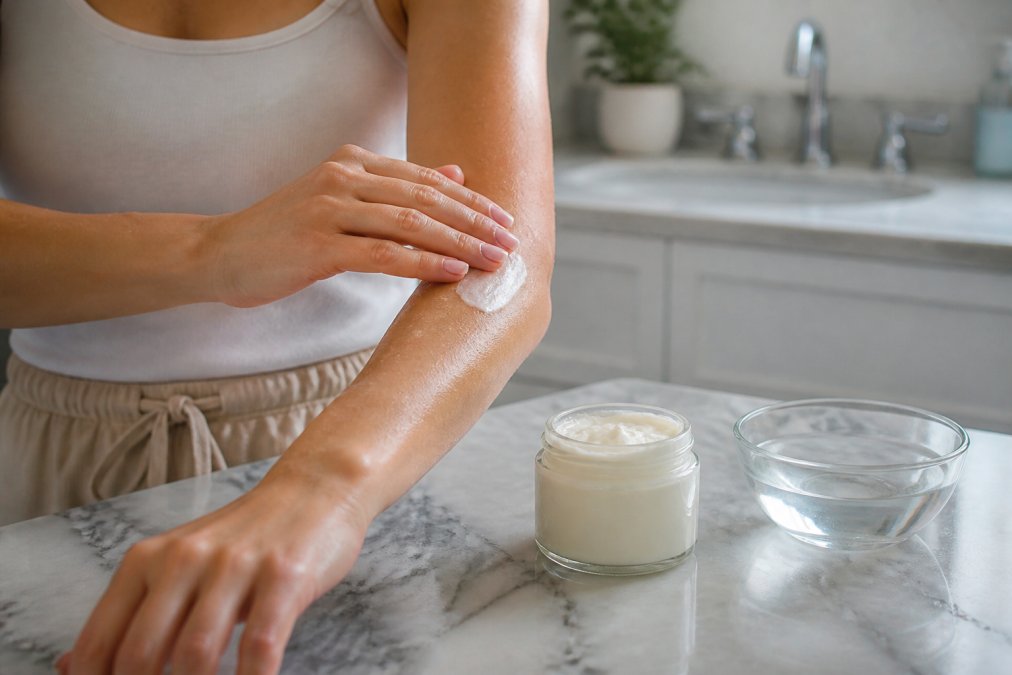
Water and oil don't mix, but they cooperate. Applying an oil-based balm to damp skin helps it spread thinner and traps surface moisture, supporting hydration and reducing trans-epidermal water loss (peer-reviewed research). That's why damp application is the default, but the amount of water and balm should shift with your skin type.
- Oily skin: Apply to barely damp skin, a light mist, not a dripping face. Use a pea-sized amount or less, and press rather than rub. Excess water plus excess balm produces the slick film oily skin complains about. Many do better applying at night only and blotting in the morning.
- Combination skin: Mist the whole face, then apply the pea-sized amount to the dry zones (cheeks, around the mouth) first. Carry whatever is left on your fingertips to the T-zone, you will naturally use less there without measuring.
- Dry skin: Apply to fully damp skin right after cleansing, while water is still beaded. Dry skin can handle a slightly larger amount, up to a small fingertip scoop, because a compromised barrier absorbs occlusives faster and needs more to seal in moisture.
- Sensitive or reactive skin: Start with a thin layer on damp skin every other night. Damp application reduces the friction of spreading, which matters when your barrier is already irritated.
A useful rule of thumb: the oilier your skin, the less water and less balm you want; the drier your skin, the more of both. If you are unsure where you fall, start with the combination-skin approach and adjust from there.
Wait Time Expectations by Skin Type
Most advice on this topic is anecdotal, "wait a few minutes", which tells you nothing about whether your result is normal. Here is a more concrete framework. These are typical ranges, not guarantees; room temperature, humidity, and how much you applied all move the number.
- Oily skin: Expect the balm to settle in about 2 to 4 minutes. If your face is still visibly shiny at 10 minutes, you used too much, halve the amount next time.
- Combination skin: Expect 3 to 5 minutes, with the T-zone taking the longest. If the T-zone stays slick past 10 minutes, skip it on the next application.
- Dry skin: Expect 5 to 10 minutes for a full absorb, and a soft, cushioned finish rather than a matte one. Dry skin often retains a light sheen by design, that residual layer holds water in.
- Cold rooms and winter: Add roughly 2 to 3 minutes to every range above. Cooled tallow is firmer, spreads more slowly, and absorbs more slowly.
- Warm, humid rooms: Subtract 1 to 2 minutes. The balm stays softer and breaks down faster.
The ten-minute test is the one number worth remembering: if your skin still feels greasy ten minutes after application, the problem is quantity, not the product. Cut the amount in half before changing anything else.
Why Whipping Changes the Application Math
Whipping changes the application math. A lighter, airier texture means you pick up less product per finger swipe and it breaks down more evenly across your face, which is why the pea-sized amount above is realistic for whipped tallow but would be far too little for a dense, unwhipped balm, and why does whipped tallow leave skin greasy far less often.
Tallow Moisturizer for Oily Skin: Does It Clog Pores?
A tallow moisturizer for oily skin sounds like a contradiction, but the concern is fair: will it clog pores? Tallow is generally considered low on the comedogenic scale, though ratings vary by product and processing. The ingredient itself is not the main risk, over-application is, along with the rest of your routine layered underneath.
Comedogenic Rating and Skin Adjustment Period
The comedogenic rating system scores ingredients from 0 to 5 based on pore-clogging likelihood in rabbit-ear testing, an imperfect proxy for human skin. Tallow typically falls in the low range, similar to many plant butters and oils. But a rating is a starting point, not a guarantee, your skin microbiome, routine, and how much product you use all shape the outcome.
Two mechanisms drive most tallow-related congestion, and neither is the fat itself:
- Occlusion trapping debris. A heavy layer of any occlusive can seal dead cells, sweat, and leftover product against the pore. The fix is a thinner layer, not a different ingredient.
- Oleic acid sensitivity. Tallow contains oleic acid, which some acne-prone skin tolerates less well than linoleic-dominant oils. If you consistently break out with tallow but not with lighter oils, oleic acid may be the variable, not the comedogenic rating.
If you're coming from a water-based moisturizer, expect a one- to two-week adjustment period. Some notice small congestion early on as skin adapts; others notice nothing. Start with a thin layer every other night, then build up.
How to Adjust Application for Oily Skin
Oily skin doesn't have to skip tallow, it has to use less, less often, and in a different position in the routine. A practical protocol:
- Start at night only. Apply a pea-sized amount to damp skin before bed. Skip morning application entirely for the first two weeks.
- Skip the T-zone on the first pass. Apply to cheeks and perimeter first; carry only the residue to the forehead and nose.
- Alternate nights. Use tallow every other night and a lightweight water-based moisturizer on the off nights. This gives you a clean comparison if congestion appears.
- Layer under, not over. If you use a hydrating serum, apply it first, let it dry, then apply tallow. Oil over water spreads thinner than oil over oil.
- Reassess at two weeks. If skin is clear and comfortable, you can add a morning application or increase to nightly. If congestion appeared, cut back to twice a week and re-evaluate.
Tallow vs. Plant-Based Oils for Oily Skin
If your skin is genuinely oily, it's worth knowing how tallow compares to the plant oils often recommended as lighter alternatives:
- Jojoba oil: A liquid wax structurally close to human sebum, generally well tolerated by oily skin. Spreads thinner than tallow but offers less occlusive seal.
- Squalane: A fast-absorbing emollient with a very low comedogenic profile. The closest plant-derived match to tallow's lightest fractions, and a good option if tallow feels too heavy.
- Rosehip and grapeseed oils: High in linoleic acid, which some acne-prone skin prefers over tallow's oleic content. Lighter but oxidize faster and offer less barrier support.
- Shea and cocoa butter: Heavier than tallow and higher on the comedogenic scale. If tallow already feels greasy, these will feel worse.
The trade-off is consistent: lighter oils spread more easily and clog less often, but seal in less water. Tallow's advantage is its similarity to your skin's own lipids; its disadvantage is that the same richness that supports a dry barrier can overwhelm an oily one. For tallow's barrier benefits without the weight, blend it, a small amount of jojoba or squalane mixed into a scoop thins the texture without eliminating the occlusive layer.
Grass-Fed Sourcing and the Purification Process
Sourcing matters more than most people realize. The purification process, sometimes called rendering, determines how clean the final fat is. Poorly rendered tallow keeps impurities, which can affect texture and how your skin responds.
Grass-fed beef tallow comes from cattle raised on pasture rather than grain. Many buyers choose it for its better nutrient balance and because pasture-based farming aligns with their values. Look for a supplier who describes their rendering method and can answer questions about where the fat comes from. Vague sourcing claims are a red flag.
We keep our ingredient list short on purpose: simple, real ingredients, no synthetic fillers, no petroleum by-products. The goal is a balm that behaves like your skin's own oils, not a chemistry experiment.
Ingredient Pairings to Reduce Greasiness
You don't have to use tallow alone. A few pairings can thin the texture and cut the shine.
- Jojoba oil: Lightweight and structurally close to sebum, it helps the balm spread further.
- Squalane: A fast-absorbing emollient that reduces the heavy feel without diluting the occlusive benefit.
- Aloe or hydrating serums: Layer these underneath to boost skin hydration and give the balm something to seal in.
- Arrowroot powder: A tiny pinch mixed into a scoop can mattify the finish, useful for daytime wear.
The oil-to-water ratio of your routine matters too. If everything you use is oil-based, the shine stacks up. Balance heavier products with a hydrating water-based layer first.
Common Mistakes When Applying Whipped Tallow
Most greasy complaints trace back to a handful of habits. Here's what to watch for:
| Mistake | Why It Causes Shine | Fix |
|---|---|---|
| Applying to dry skin | Balm sits on the surface | Pat onto damp skin |
| Using a full scoop | More product than skin can absorb | Start with a pea-sized amount |
| Skipping the warm-up | Cold balm spreads unevenly | Warm between fingertips first |
| Layering over heavy serums | Oil stacks on oil | Use water-based layers underneath |
| Reapplying too soon | Skin hasn't finished absorbing | Wait three to five minutes |
A common mistake is judging the product after one use. Skin needs time to adjust. Give it a week of consistent, thin applications before deciding.
Conclusion
The greasy feeling people associate with tallow is almost always a technique issue, not an ingredient flaw. Apply less, apply to damp skin, warm it first, and give it a few minutes to settle.
Frequently Asked Questions
Why does my whipped tallow feel greasy on my skin?
Whipped tallow can feel greasy if you apply too much or use it on dry skin. Tallow is an occlusive moisturizer, meaning it forms a breathable seal over your skin to lock in water. Without enough moisture underneath, the tallow sits on top rather than absorbing. Try applying a tiny amount to damp skin after a shower, and give it 5-10 minutes to sink in.
Is tallow moisturizer for oily skin a good idea?
Yes, tallow can work for oily skin because its fatty acid profile is similar to human sebum. Unlike heavy plant oils that may sit on the surface, tallow's stearic and palmitic acids help support the skin barrier without over-stripping. Start with a pea-sized amount once daily. If your skin feels greasy, reduce the quantity rather than skipping the product entirely.
How much whipped tallow should I apply for best results?
Start with a pea-sized amount for your entire face. Warm it between your fingertips first, then press it into damp skin. Whipped tallow is concentrated, so a little goes a long way. If your skin still feels greasy after 10 minutes, you used too much. Adjust down rather than adding more product.
Does whipped tallow absorb quickly into the skin?
Whipped tallow absorbs within 5-15 minutes for most skin types. The whipping process incorporates air, which makes the texture lighter and helps it spread more easily. Absorption rate depends on your skin's hydration level, the room temperature, and how much you apply. Applying to damp skin speeds up absorption significantly.
If your skin barrier is compromised or you're tired of heavy moisturizers that sit on top, Obsessedwithtallow makes whipped tallow moisturizers designed to sink in. Our balms are bio-identical to your skin's natural oils, rich in vitamins A, D, E, and K, and free from synthetic fillers and petroleum by-products. Get started with Obsessedwithtallow and give your skin the deep, lasting hydration it's been missing.